Saturday, January 9, 2016

'"Travel is an exchange, not a commodity

Impact.  Clearly travel comes with costs and benefits both to the traveler and to the local communities.  Being a sustainable traveler comes with a responsibility to be both conscious and conscientious about the impact we are making on the world.  In an ideal world, our travels and actions while traveling will make the world a better place.

We have been talking about our travel ethos since we have been here and have looked at several resources to guide us.(references below)

The MC in Ecuador groups has adopted some guiding principles for this journey:

1. Reduce, reuse, recycle
 - bring and use a personal water bottle where possible (many also brought bacteria filters like LifeStraws to be able to do this more)
- be educated about biodegradable products (Ecuador travelers were conscious about bringing biodegradable products like soaps, sanitizer, laundry detergent where possible)
- Reduce waste through efficient use of food and water. (It was easier to take shorter showers in the jungle where they were really cold 😜)
- be conscious of our energy usage ( turning out lights, using public transportation, etc)
- be mindful of and pick up litter


2. Be informed
For us this meant learning about the locations, cultures and environmental issues related to where we were going to beforehand.  What are the different issues the diverse ecosystems we are visiting are facing?  What is the impact of tourism on the places we are visiting?  What animals are endangered and what are the cultural products we need to be careful of?  Ask questions when we don't know if products are endangered species or valuable artifacts.  Be informed of the products we are buying.


Researching the destination involved each one of us writing a site paper on a location we were visiting and using tools like the CIA Factbook and Travel.State.Gov among other resources and blogs.

It has been hard to figure out taboos and norms with only a few days in each place and sometimes we have found that what we researched beforehand didn't seem accurate upon arrival.

3. Buy local
On this program we have carefully selected our providers based on a commitment to ensure our money goes into the local economy.  We are committed to staying in locally-owned accommodations, using local and public transport, buying local and eating local (this is easier to do in a country where it is easier to find local establishments than international ones!).  We have been conscious about spreading our spending across local communities as we travel and supporting local guides.


(Yes that is popcorn in my soup!  So delicious!)

4. Be bold and engage with locals.  
- Speak the language.  Learn and use phrases from the local language as much as possible.
- Make an effort to learn from the people we encounter.  Ask questions.  Seek understanding
- Be aware of behavior norms, body language and local customs.  Adapt behaviors and attitudes to be more successful culture learners.
- Learn to listen and speak with respect and represent different points of view
- Check your reactions. Learn to recognize your emotions and react appropriately for the situation.
- Recognize diversity in populations. Try not to generalize about norms and mores when it is not appropriate.

5. Evaluate sustainable practices of tourism providers.
- Since sustainability can mean many things, we want to make choices to support organizations that demonstrate care for the environment, animals and local culture.  We used our resident horse expert (Kelsey) to help us decide if the horseback riding provider had healthy animals and good practices.


6. "First do no harm" (Hippocratic oath) but then also contribute something.  We are looking forward to the opportunity to volunteer with Street Children in Quito.  We are participating in this Planeterra project near the end of our program, but are looking for other ways that we can leave each space better than we left it by designating students with roles related to sustainability.


7. Seek out authentic experiences 
Be it eating TREE GRUBS or GUINEA PIGS, or asking questions about the indigenous art we are buying, we will learn as much as we can about food, art, music and culture in authentic ways and environments. 
We will learn about the place we are visiting.  On our horseback ride in Banios we not only saw the region by horseback (clean energy ;)) but we also learned about the volcanic activity and remmenants of the area.  We learned about traditional medicines and found pure spring water.

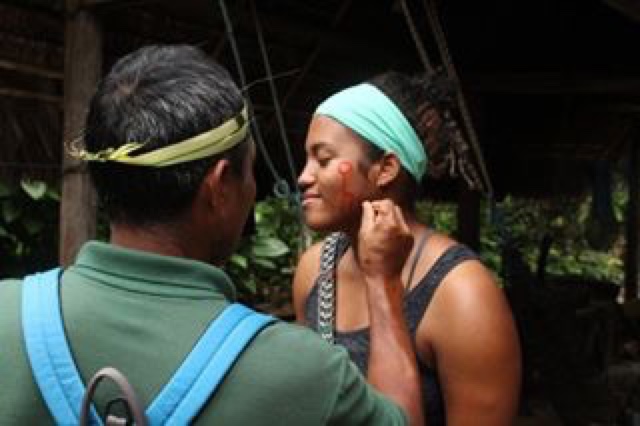
8. Leave your preconceived notions at home.  Have an attitude that embodies openness to learning and difference.  Be open to our common humanity.  In our case, we were welcomed by the Quichua tribe in to his family.   In a powerful connection of our humanity, Delfin drew symbols on our faces with achote.  Each one had meaning to him and his traditions and were meant to keep us safe on our journey that day.  In return he allowed us to put symbols on his face.  Our group drew mountains to connect his mountains to ours on one side and a symbol of Maryville College (power M) on the other side.  


This is just the beginning.  We hope to come up with a responsible travel ethos for all Maryville College travel programs to follow!

http://www.yale.edu/yalecollege/international/sustainability/tips.html 
http://www.responsibletravelreport.com/travel-green/travel-tips/during-travel 


The Ultimate Equine Experience in Ecuador

Yesterday in Baños was one packed full of adventure. Early in the morning we set out on a tour to see the city's beautiful waterfalls and we even payed a visit to the famous swing at the end if the world. Though these were great experiences, as the equestrian of the group, I would have to say that the highlight of the day was our afternoon trail ride. Our guide and owner of the ranch (José and Two Dogs), José, was absolutely wonderful and helped us all, even those with little or no experience, to have a great time. This experience really stood out to me because of its incorporation of sustainability, which is the topic of our class. As sustainable travelers, it is our responsibility to engage in activities that promote sustainability. Animal welfare is a part of the sustainable experience. We had worried about whether or not the horses we would be riding were well taken care of since there are many ranches who mistreat and overwork their horses all around the world. We were very pleased to see that, not only were these horses happy and healthy, but they also enjoyed more vacation (pasture) time than most working individuals. It was a refreshing experience that most definitely aided in our journey as sustainable travelers.

Wednesday, January 6, 2016

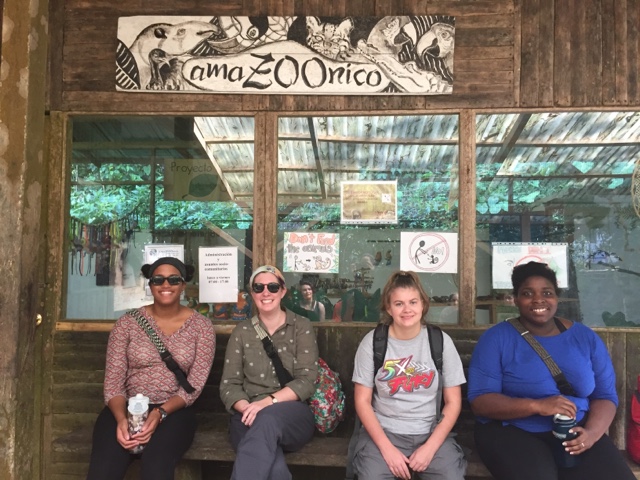
AmaZOOnico - Ecotourism in the Rainforest?

What began with a ride on a very low-riding motorized canoe, left us with questions about how to define conservation.

Ecotourism is defined as ecologically sound tourism, and is generally judge by 3 criteria:
1. Provides for environmental conservation
2. Includes meaningful community participation 
3. Is profitable and can sustain itself

AmaZOOnico Rescue Center is located in Tena, Ecuador, right on the Rio Arajuno (part of the Rio Napo). It is an animal rehabilitation center that cares for confiscated rainforest animals.  They make every effort to reintroduce animals back into the local environment, but at times we learned that it is impossible, and so the center has become a permanent home for many animals from monkeys to tapirs, to toucans.  The reasons varied, but among them were issues related to viruses that some of the birds were exposed to, and primarily the impact of having been around humans so long that they were no longer fearful to be around them, and hadn't learn how to survive in the wild.  One other common reason was that so that indigenous tribes wouldn't hunt endangered birds for their feathers for traditional rituals.  The center is focused on saving animals and is staffed by volunteers from around the world.

It was clearly a well-thought out ecotourism site, but we were left with a question about the local context:

The animal preservation was from a Western cultural lens. In some cases the animals were being protected from indigenous peoples practices. We wondered about the other side of the argument.  


"Who needs soap when you have nature?" Local Living In Pimilala

"We just want to see your way of life, hang out with you and learn about life in the jungle" - Bruce Poon Tip

The Founder of G Adventures, Bruce Poon Tip, wrote this in his book Looptail, explaining to Delfin, the father of his Quichua family, why he wanted to spend time in the jungle with him and the rest of his family.  The Quichua people are the largest of the 13 indigenous groups in Ecuador (and actually make up 2 of the 13 groups - highland Quichua and rainforest Quichua).  Their encounter led to the beginning of a long friendship and a long business partnership in which G Adventures would take small groups of travelers on a homestay experience in Delfin's community.

For this class, we are both traveling on a G Adventures tour and shadowing the organization to see how it implements sustainable tourism.  We eagerly anticipated meeting Delfin - already famous from our pre-departure reading.  Each of us had different expectations of what life in the jungle would be like.  This part of our program offered much more than a 'jungle excursion.'  We arrived to our home nervously anticipating insects, a language none of us spoke, and a hope for a glimpse into the world that Bruce Poon Tip encountered many years ago.  I'm not sure any of us imagined how much could happen in just over 48 hours.  From learning about traditional medicines to hunting techniques, to making our own chocolate from cacao beans, we got a snapshot into Quichua life and traditions.

There were so many remarkable moments it is almost impossible to know where to begin.

On Monday we arrived in 4x4 trucks to a remote part of the Amazon jungle to live with Delfin's and his family for 2 nights.

After settling in to our rooms and having some time to eat dinner (we ate lots of rice, plaintains, yuca, and some of us even ate tree grubs) the group had a chat by a campfire with Delfin in which he told us about Quichua traditions, religion, and family. The Quichua practice what could be considered a fusion of Quichua indigenous religion and Catholicism. When we asked Delfin what he practiced, he told us he was a Catholic. His Catholicism, however, is very connected to indigenous beliefs about the Amazon jungle and the spirits that live there. For Delfin, every element and person in the jungle has a spirit, and this aspect of his religion is defined by duality; everything's spirit can be either good or bad. Delfin's decision making is often guided by his dreams. For instance, we planned to go on a hike and Delfin was going to stay back at home, but he had a dream in which a black dog was running across our path. This black dog represented an evil spirit for Delfin, so he decided to change his mind and hike with us for our protection.

We also were able to participate in a reenactment of a traditional Quichua wedding; there are actually three weddings in this tradition, one Quichua, one Catholic, and one civil. 

Our group had so many experiences in the jungle. It was amazing to sleep in a cabin in the middle of the rainforest with no electricity, it seems like everything would be quiet and peaceful, but the sounds of the insects and animals were louder than in many cities. We did everything from relaxing in hammocks to hiking to 4 waterfalls to making chocolate from cocoa beans picked from the jungle. We learned about traditional jungle medicine, how to trap animals, and how to climb a tree using only leaves made in to a rope. 

From a Sustainable Tourism perspective, we evaluated the changes that tourism has brought to Delfin's family. With the money they've made from their partnership with G Adventures, they have been able to expand their structures by building more living spaces for the tourists. Tourism has shifted the family's work from agriculture and has brought them economic prosperity and stability. Delfin has come to understand through his interactions with tourists that we are all "una gente"-- one humanity. He hopes to instill these values in everyone he meets and be able to educate people about culture and the environment. There are many issues to consider when talking about sustainable tourism, but this model seems to be working for Delfin, his family, and the tourists. 

Sunday, January 3, 2016

Starting out Sustainably

We made it safely to Quito. 9350 ft. Everyone arrived happy and excited to the hostel. But...turns out that altitude is a sneaky thing that hits you quick and affects sleep and makes you nauseous. We are headed down to 'el Tena' today (1675 ft)  Our journey begins by joining the local population on a 6 hour bus ride at 8 am. 

We started out staying sustainably at a Leeds Certified hotel! We will learn more about how green certification contributes to sustainable tourism when we are back here. 


Saturday, January 2, 2016

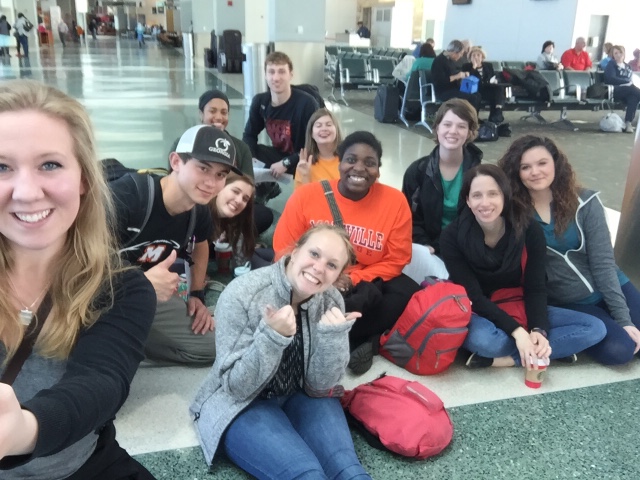
Leaving Knoxville TYS-ATL-UIO

First Glimpse at Quito

Brynn Smith, our program assistant, arrived early to re-visit some of her study abroad haunts.  Here are a couple of snapshots to see where we will be!

New Year's Parade

El Panecillo